I nearly passed the ticket on out of laziness. I am glad I went: it was well worth it.
The venue“Static immersion”, even in a room this large
The venue looks like an assembly hall. We have seen plenty of immersive work in small theatres; “static immersion” in a room this size was new to me. It has to depend on a room and a story that fit each other exactly.
Immersion means more than scattering characters around the building. Light and sound have to follow: the lighting must reach the whole room to count, and here there is a small speaker on every desk. Then there is the jury, which uses two of the ideas I had imagined after seeing the Chinese studio version of Thrill Me, to my amusement. The jurors are members of the audience, who stand with the court each time and even get to speak.
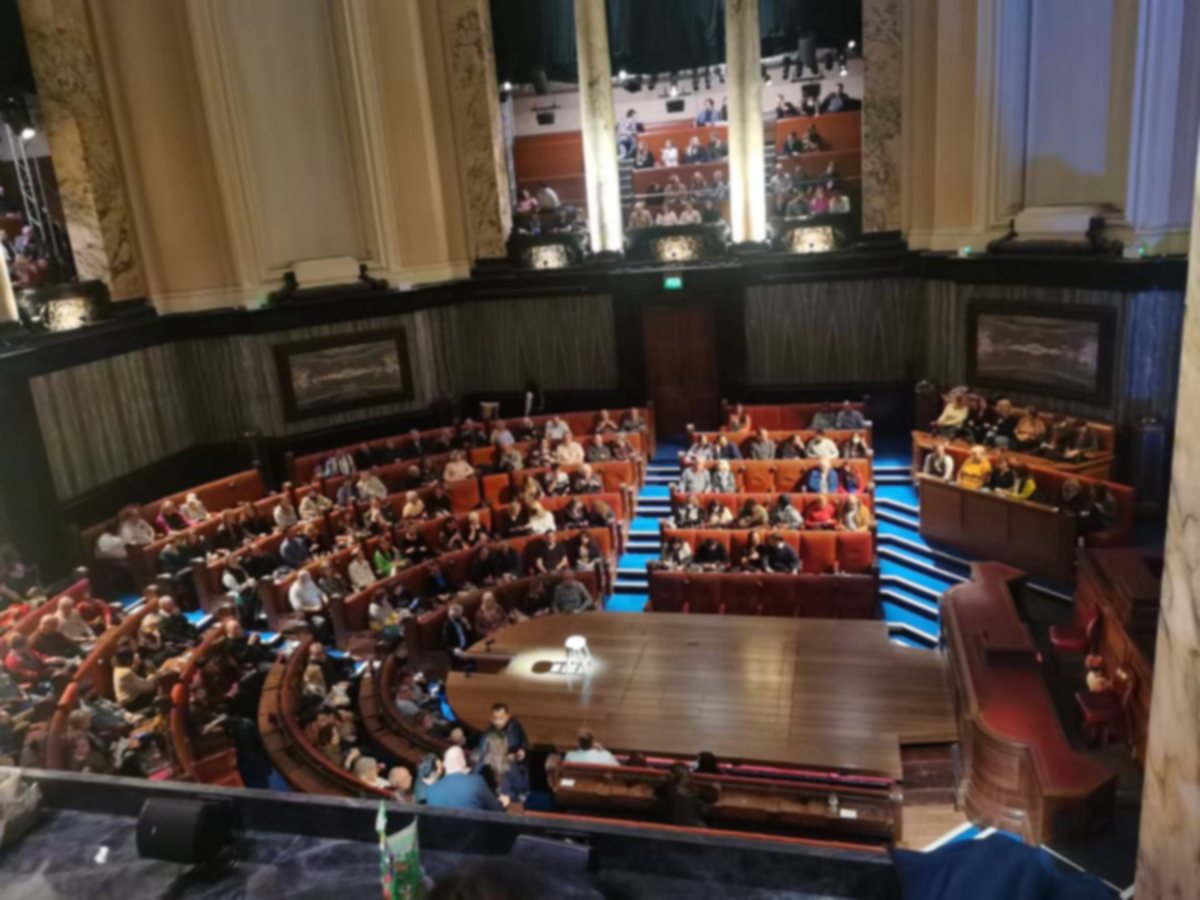
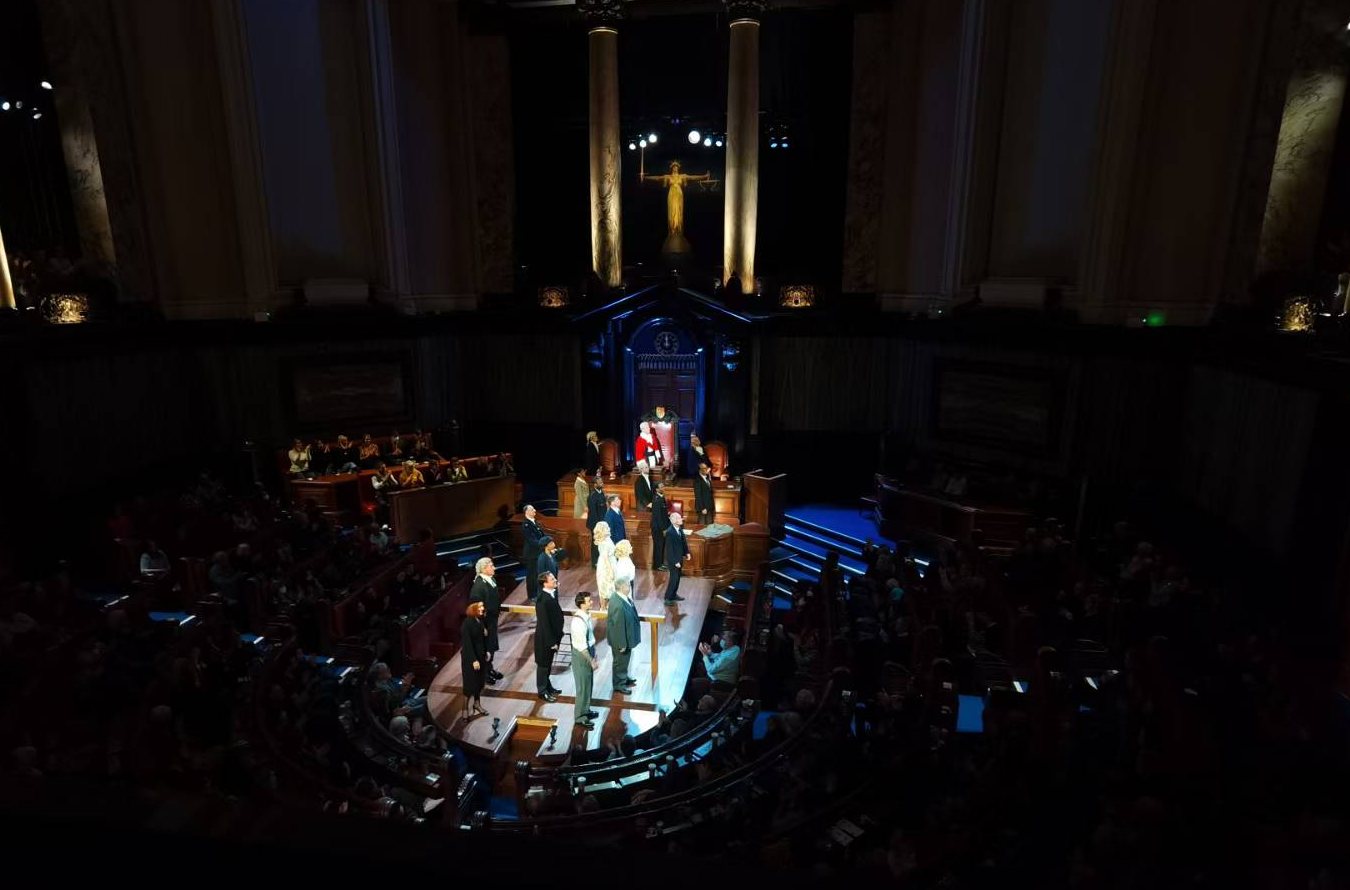
The props are carried on each time through the doors at floor level (usually three of them) by the actors, in an orderly and logical way, every movement choreographed. The scene changes are long, but the music holds the atmosphere exactly, and the carrying itself is worth watching, so it never drags.
SeatsIf you must sit at the side
My seat was at the side of the gallery. If you must sit at the side, choose stage right. Not seeing the jury hardly matters; not seeing the witness box is maddening, like an English listening test. The restricted view should not have been this bad, but that day five of us were sharing a bench meant for four, and the pillar blocked even more. I saw almost nothing of the housekeeper’s testimony in the first half, which I regret.
ActingPlaying innocence to the hilt
The leading man is a fine actor. The audience’s reaction to the twist at the end showed how completely he had played innocence; and he has little stage experience, this being his West End debut.
So afterwards I wanted his autograph. He was in the foyer talking to a group of friends and I did not like to interrupt; as luck would have it, one of them asked me to take a photograph of the whole group. That would have been the moment to ask, but before I could get a word in they were deep in conversation again. I then fell into talk with another member of the audience I had just met, and by the time we said goodbye the party was two hundred metres down the road. I ran after them. That is me: I do not let a chance go. In a few years he may still remember the stranger who took the group photograph and then chased them down the street for an autograph.
I bought a programme afterwards. The fridge magnet was only £2.50, and somehow I did not buy it.
AdaptationHow a short story fills a whole evening
During the day I had wondered how this story could be stretched to a full evening. The answer is a wealth of added detail. Where the original has a single sentence to say that the witness is broken down, the stage version supplies the lines by which it happens. Most of what is added is courtroom procedure, which suits the venue perfectly; the rest is detail that follows from it.
As an experience, there are only so many points of suspense, and the reversals are gathered at the end; drawing out what comes before slows the rhythm of the pleasure, and is less exhilarating than simply reading the script. For more than nine tenths of the evening the audience trusts the hero more and more, so it has to look for a suspect among the other characters, and none of them seems very likely, unlike The Mousetrap, where everybody does. Once the pace drops, then, the audience’s minds spend longer in low gear. That is the drawback as I see it, though the mass of courtroom detail goes some way to make up for it.
The endingTwo extra twists (the ending is discussed below)
Finally, the stage version adds two small twists to the original story. One is that the hero has another woman: once acquitted, he discards the wife he has used, overturning our belief that her scheme came from the depth of their love. Then the wife, in despair, stabs him dead, which is logical and very sad. But I find this addition superfluous, and not especially good. I would rather end on that enormous reversal delivered in a few short lines. “I knew he was guilty”: what a last line, enough to raise goosebumps.
I would rather end on that enormous reversal delivered in a few short lines.
Thoughts from this seat
- Immersion in a room this large depends on a room and a story that fit each other exactly.
- Not seeing the witness box is like sitting an English listening test.
- Drawing out what comes before slows the rhythm of the pleasure.
 Tianjiao TanProducer and writer. Makes theatre, and sits in the audience for everyone else’s.About me →← All reviews