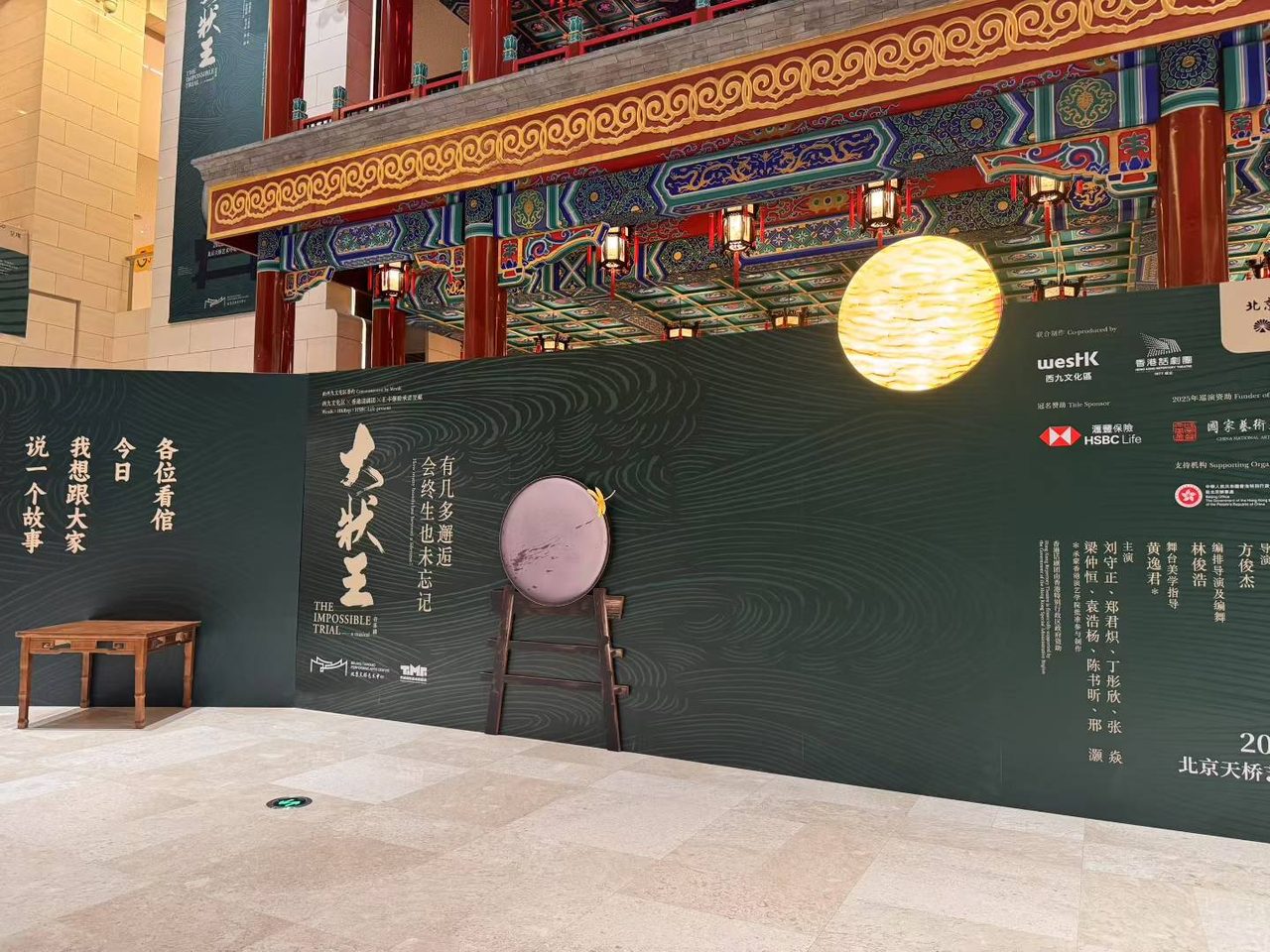
It is good, no question, but not as dazzling as I had imagined. Chinese-language musicals are on the whole so weak that this standard, in a big house, comes along once in several years; it beats The Orphan of Zhao, another costume piece and one that says one thing while meaning another, by a very long way.
The story is fresh. A man and a ghost sharing one fate is fun, and a look at good and evil in human nature, especially a villain turning good, will always hold the eye. The plot is tight, the pacing is right, and everything is told very clearly.
TearsI cried twice, and neither time for Fong Tong-geng
I did cry. Once when Ah Sai (Sung Sai-kit) wants to ask Fong to call out “mother” for him and, before he has finished speaking, Sau-sau says it; that understanding between the living and the dead got me in a second. And once at the end, when Sau-sau’s song is so full of longing and reluctance to let go that the feeling carried me into tears.
What surprised me is that the tears did not come at Fong’s self-sacrifice, or at his inner struggle: whether to give himself up for everyone and pay for his wrongs, or, having become a good man, to go on doing good and live on with the guilt. I was hoping for a song to dig into that. Instead he decides in a flash; I couldn’t tell why Ah Sai is able to kill him, or why that counts as an evil deed, and it is over in a hurry. My feelings had nowhere to go, and that was uncomfortable.
At the end Sau-sau doesn’t sing about good and evil, or about Fong and Ah Sai, or about love for the wider world; she stays with her private feelings (or perhaps the lyrics said more and I didn’t catch it). It left me a little hollow, with an ending that didn’t quite satisfy. But that is a matter of taste.
LogicContrived coincidences, and a chain of cause that isn’t the only one possible
The logic mostly holds, with two small faults. One is that some contrived coincidences pull you out of the play. The woman in the opening number has to be sick in the courtroom, of all moments, and be found out; the pharmacy owner suddenly has to have a sickly son. If these had been touched on lightly elsewhere (not repeated), and given some other small job to do, they would not jar so much. But these are flaws that don’t spoil the whole.
The other is the ghosts and gods. The figure called the Eighth Master, or the White Impermanence, or whatever he is (the person I went with took him for a chicken), eggs Ah Sai on to take revenge on Fong, and I was lost. If Ah Sai couldn’t bring himself to kill Fong back then, why can he after eighty-one evil deeds? He won’t commit this one evil (killing Fong), yet he can bear to spend sixteen years helping him commit eighty? Why, later, will more people die if Fong doesn’t commit the eighty-first? What gives the Eighth Master the power to threaten that? Ah Sai isn’t tied to Fong twenty-four hours a day, so why hasn’t he been home to see his mother in all these years (the show raises the question itself, which doesn’t make it add up)?
The monk who asked the Golden Dragonfly for medicine did good and reaped so much harm that he lost his faith; does learning that this man and this ghost can crack the poison case and save thousands cancel out the innocent lives already lost? And if Fong had gone through with all eighty-one, would the pair still be the Golden Dragonfly? The chain of cause lacks a single necessary path: it isn’t “whichever way you go, you end up here”, it is “one wrong step in the middle and none of this happens”. A fate like that loses some of its force when you look closely.
SongsFlawless as singles; inside the show, like having no surtitles
The plot songs are nearly all tight and do their job to the full, at some cost to the pleasure of listening (I nearly missed the reprises). I think only the second number is a character song: it gives us Fong’s mind while he is still a villain. It doesn’t carry much information, which is just right for easing a first scene as vast as an act.
There are some songs of inner life, though not purely that. These I find both good and bad. They are full of abstract expression and lovely metaphor, but sometimes I truly cannot tell what they mean; by the end of a lyric all I can do is take in a mood. As singles they are beyond criticism. Inside a musical, I felt as if I were watching a foreign-language show with no surtitles (there were surtitles; I read them and still didn’t follow, it was too deep, too indirect). You have no time to stop and think while a show is running. Two songs like this in a musical are the finishing touch; many of them only confuse me.
As singles they are beyond criticism. Inside a musical, it is like a foreign-language show with no surtitles.
Take Sau-sau’s solo in the snow: I didn’t know what she was lamenting. The state of the world? But her storyline afterwards is mostly personal. If this is planting her later attempt to end her own life, isn’t it planted rather far away? Her role is a little like Meg in The Phantom of the Opera, where lifting the mask at the end is enough of a finishing touch; too much inner life and you lose the link to the main plot. She has a love story, yet only about half a song seems to be about it.
In short, there is not enough first-person anatomy of what the characters feel: too much ornament, too hard to follow. And yet some of the indirection I loved, such as never saying outright, only hinting in the lyrics, what Sau-sau means to do. There are several such places, and they have the beauty of restraint.
The style of the songs suits the story and they are a pleasure to hear. A few I thought very good, though no tune quite reached earworm level. The songs benefit from Cantonese itself, and from the way Cantonese lyrics are written: sung straight in Mandarin they wouldn’t sound this good, yet that way of writing still beats plain speech.
CharactersSixteen years an accomplice, changed overnight
One piece of moral argument I did like is the monk’s dialectic: you try to do good and end up harming people, and it seems good cannot overcome evil, so you stop believing in good; but does letting things take their course guarantee a good outcome? That made me think. And when Fong gives up his other chances to overturn the case and decides to die, part of it is that he “cannot live at ease after doing wrong”, which I think enriches the motive. The shortcoming is that this unease is given too little preparation and development earlier on.
On characterisation: Ah Sai has been an accomplice for sixteen years without realising he was doing wrong, and when he suddenly does realise, the change is passed over too lightly. For a person that would be a huge shock; it can’t stop counting just because he is a ghost.
Fong has been a self-consistent villain for sixteen years (his first solo shows it: the persona and the values are rock solid). Refusing to go on doing evil because he is afraid to die makes complete sense. But from the moment he saves Sau-sau he has fallen in love with doing good, and that doesn’t make sense to me; the motive is weak. Saving Sau-sau is also a lone pillar. Its job may be to show that he is good at heart, so that he can turn back to good later, but there is so little evidence of that goodness that the rescue starts to look like something this character would not do.
AndSupporting roles, jokes, and the stage
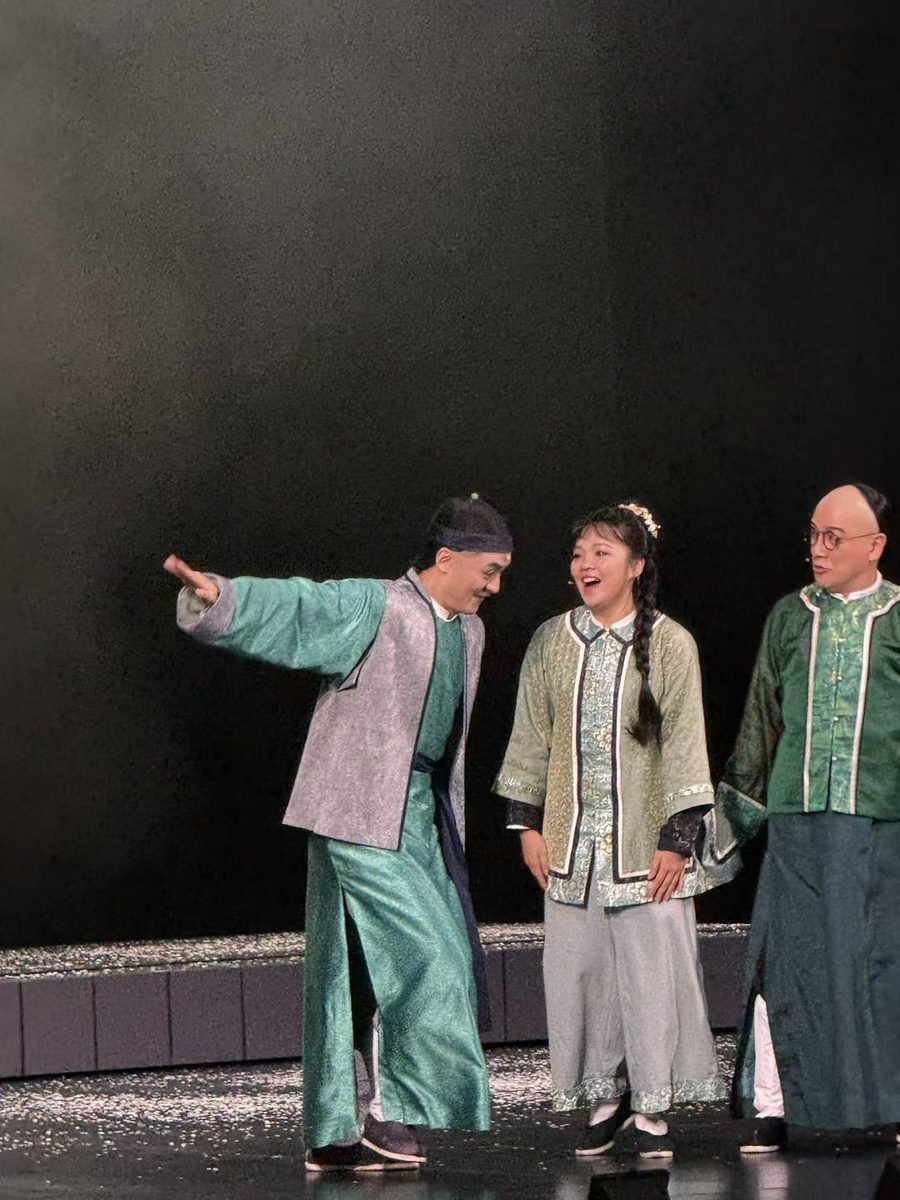
I have said my piece on Sau-sau. The supporting characters, on the other hand, each do exactly the job they are there for. Also: Fong and Ah Sai are a far more shippable pair than the man-and-woman storyline. And the writer remembers to put jokes in the dialogue for relief, which is good.
I forgot the staging: live silhouettes and a revolve. I loved it!
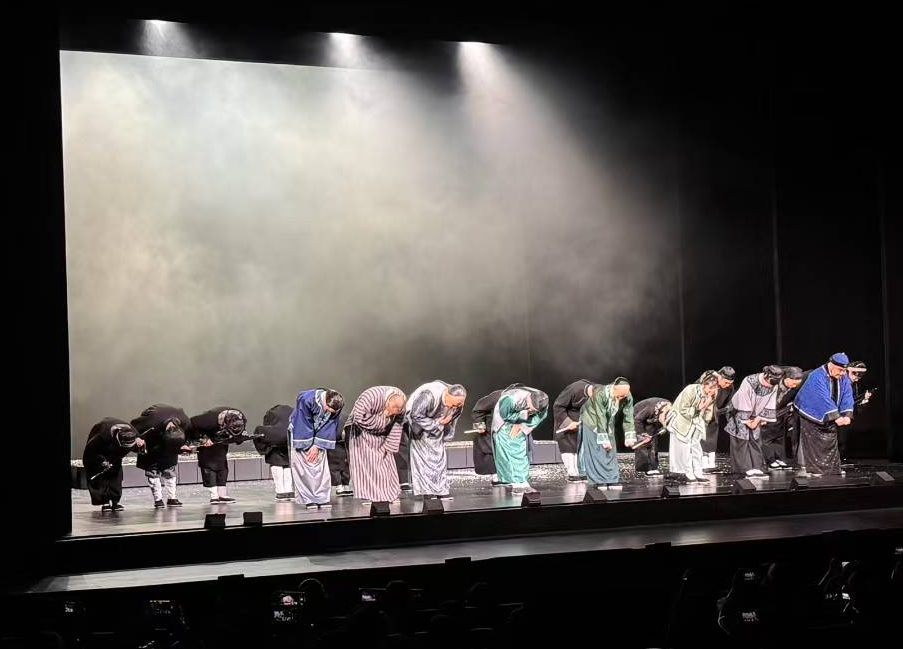
After all this analysis, I think the show has real flaws in its characterisation, but everything I haven’t mentioned is pretty good. Taken as a whole, it is still an excellent musical.
After the show: the conversation
A late-night exchange with two friends, Shango and 💛, cut down to the points. Spoilers throughout.
Question 1Who is the “Eighth Master”?
- Shango
- The Black and White Impermanence always come as a pair. Only the White one appears on stage, but when Ah Sai says “Eighth Master” he is addressing the Black one. Think of them as a double act: the Seventh Master, White, is the face, and the Eighth, Black, is what lies behind it. Both are there to collect souls.
 Tianjiao
- Now that is interesting!
Question 2He couldn’t kill him back then. Why could he help with eighty-one evil deeds?
- Shango
- Ah Sai was very young and couldn’t bring himself to do it; he didn’t want Fong’s mother to grieve as his own had. But he wasn’t willing to be the one who died in Fong’s place either, so he took the Eighth Master’s bargain for revenge. The eighty-one deeds are a buffer for someone who can’t strike the blow, and still a way of getting back at Fong; the Eighth Master gets two souls out of it, so both sides win.
- Tianjiao
- The buffer makes sense. Until then the two had only twisted right and wrong; they hadn’t directly cost anyone their life. Fong only ever asked for thirty strokes of the rod, and both are stunned when the pregnant woman from the opening dies. I heard the cause and effect in the dialogue; the logic behind it I only get now.
Question 3Why do more people die if the eighty-first deed isn’t done?
- Shango
- Later Ah Sai can’t go through with it, because of Sau-sau and because of his mother. The bargain was against the rules to begin with, and breaking it costs more: either Fong dies, or more people die in his place. For Ah Sai it becomes a trolley problem. The two Impermanences don’t decide this; they only bring the news. It is the death of the monk-turned-advocate that finally wakes Fong up. Only then does he choose to die in the Hall of Longevity case, give the seven wronged souls their justice, and settle the bargain.
- Tianjiao
- So it all comes down to Fong’s allotted fate. And by going along with him, Ah Sai may actually have been saving people: fewer to die in Fong’s place, only more miscarriages of justice.
- Shango
- I doubt Ah Sai knows whether he is saving anyone. He only knows he wants revenge and cannot go as far as killing; anything short of doing it with his own hands is easier to bear.
Question 4The last deed: who kills Fong, and why is it “evil”?
- 💛
- The Eighth Master gave Ah Sai the power to kill Fong the moment Ah Sai died; he simply never used it. In the Hall of Longevity case a healthy adult would not die from the medicine, so testing it could not have killed Fong. He has Ah Sai kill him so that it looks as if the medicine did it: false evidence to “frame” the pharmacy. That is his last evil deed, the eighty-first.
- Tianjiao
- I follow that, but I count it as a good deed. Otherwise selling Sau-sau to the consumptive man would have to count as an evil one too.
- Shango
- In the end Fong has Ah Sai kill him, which you can also see as a kind of suicide.
Question 5What is Sau-sau’s song in the snow for?
- Shango
- “Fine Snow” is both her bodhisattva-like illusion about Fong and a protest against injustice: snow in June. It isn’t a song of decision; it is a portrait of how she has felt all along. He got her out of the brothel, and he keeps turning right and wrong upside down, so her feelings for him are torn. And there is Ah Sai’s love for her. Guangdong never sees snow; this snow falls because Ah Sai makes it fall for her.
- Tianjiao
- The dialogue already makes that state of mind clear. The song drives no decision and plants nothing for later, so as a piece of the machinery it is a spare part. It is truly beautiful, though. And the snow being Ah Sai’s gift did get to me.
Tianjiao TanProducer and writer. Makes theatre, and sits in the audience for everyone else’s.About me →← All reviews