At the intervalA fresh, simple story, made this complicated
I truly don’t know what this stage adaptation thinks it is.
Such a fresh, simple story, made this complicated. In a little over an hour, can it really do justice to this many character threads? It is cluttered without being good at any of it, the exact opposite of the film, which tells one main line well.
And it isn’t beautiful, not in the least; as an Asian viewer, no thank you. It feels like many of the Chinese-language versions of musicals I have seen, with the soul adapted out of them. Either change it completely and make it local, or you end up with this, neither one thing nor the other. Whether it succeeds commercially I won’t judge; perhaps it hits the spot for British audiences. I just don’t like it.
After the second halfWhere did the silence and the blank space go?
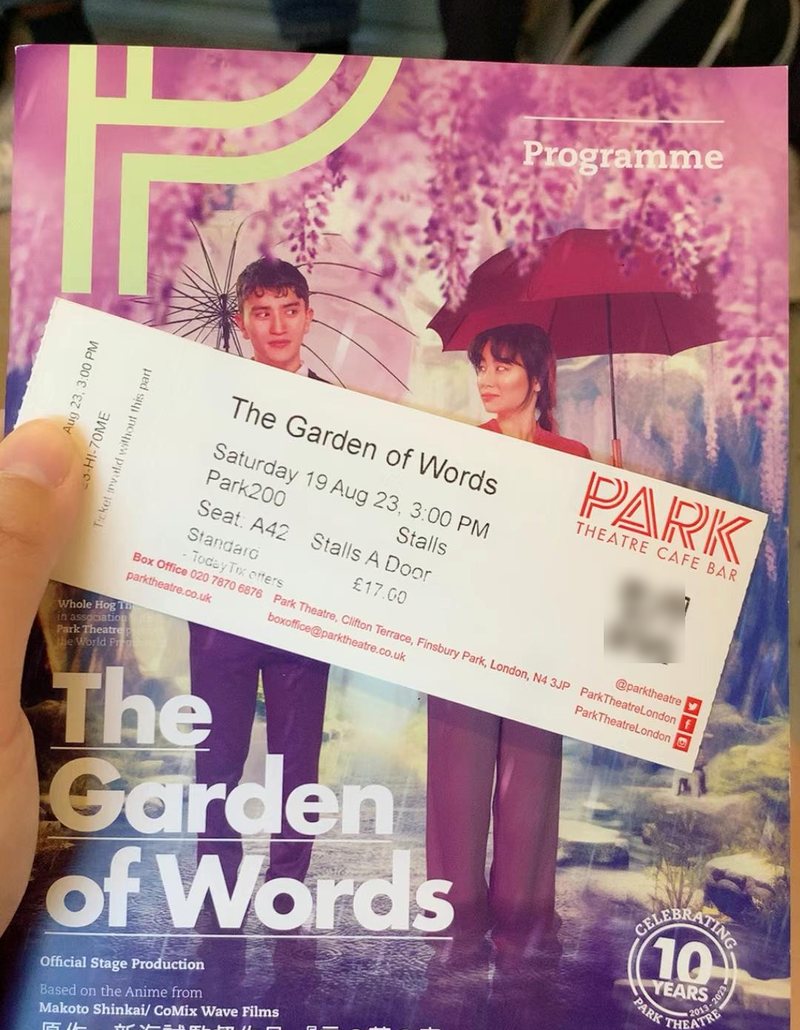
What I love in the animated film The Garden of Words is a mood, the feeling that stays with you afterwards: silence, and blank space.
The stage version hardly conveys that at all. Only near the end, in the downpour, when the two of them each change their clothes and drink tea, is the feeling right, silence saying more than speech. But there is too little of it: those two actions don’t add up to enough for them to say anything like “this is the happiest moment”. It was beautiful, but not beautiful enough.
The puppetry, to my mind, helps the storytelling well enough but never quite creates atmosphere, unless you could stop me seeing the puppet operator. I didn’t feel the bird did anything for the soul of the piece. The moments when one person, then two, spread their wings were fine by me, since both are people who “cannot take a step forward”, and flying stands for breaking through.
The production insists that all humans are weird, and it turns a piece focused on two people and on feeling (above all on what each of them carries inside) into a story of seven lonely souls. The older schoolmate’s thread does a lot, I think, to round out the characters; the brother’s thread is mainly about family background and never gets to the bottom of it; the love story is only ever touched on. Had this been a new play I caught in Edinburgh, I might have thought it was all right. But the original is Makoto Shinkai’s film, and I honestly think the adaptation has ruined it.
The music is beyond criticism; it felt as though the whole show was being held up by it.
ActingEverything unspoken has gone
The feeling is gone. I couldn’t sense that the teacher is unwell at all. In a theatre that small you ought to be able to see even the smallest flicker in a face; never mind flickers, there was no expression, no bearing. That veiled, East Asian way of expressing things is entirely missing: the shifts of someone fragile and sensitive, the smile turned to the world to cover the wound inside. None of it is there.
The older schoolmate’s performance I thought was better. The girlfriend’s was entirely Western. Mixed together, it becomes more or less neither one thing nor the other.
I did love the idea of putting on the shoes at the start.
The climaxWhere is the teacher’s fragility?
The climax was simply wrecked; it wasn’t moving in the slightest. I didn’t cry, and nor did anyone else in the room. To begin with, the teacher’s inner life is thin, her conflict isn’t shown, and she has too little reason to run after him. In the film the chase has a long path, down one flight of stairs after another, and then we get Akizuki’s back. Akizuki is badly hurt and what he says is hurtful; the teacher, who came after him, is wounded again by his words, and while that makes her more fragile, she also feels a pang for having hurt him in return. That is how complicated those tears are, and only when the feeling has built to its limit does she rush into that embrace.
The stage version instead gives us a full-blown row. Akizuki shouts himself to the floor; the teacher’s calm vanishes and she tries to defend herself and can’t; in the end she holds him where he has fallen and he cries on her shoulder. That is simply wrong. Where is her fragility? Where is her difficulty? It really has become the story of a grown-up teacher and a childish boy, and it made me furious!
At the end everybody gets a happy ending, and you can’t tell how; the motivation isn’t there, and the sorrow the director wanted to convey doesn’t last either, so I don’t quite follow.
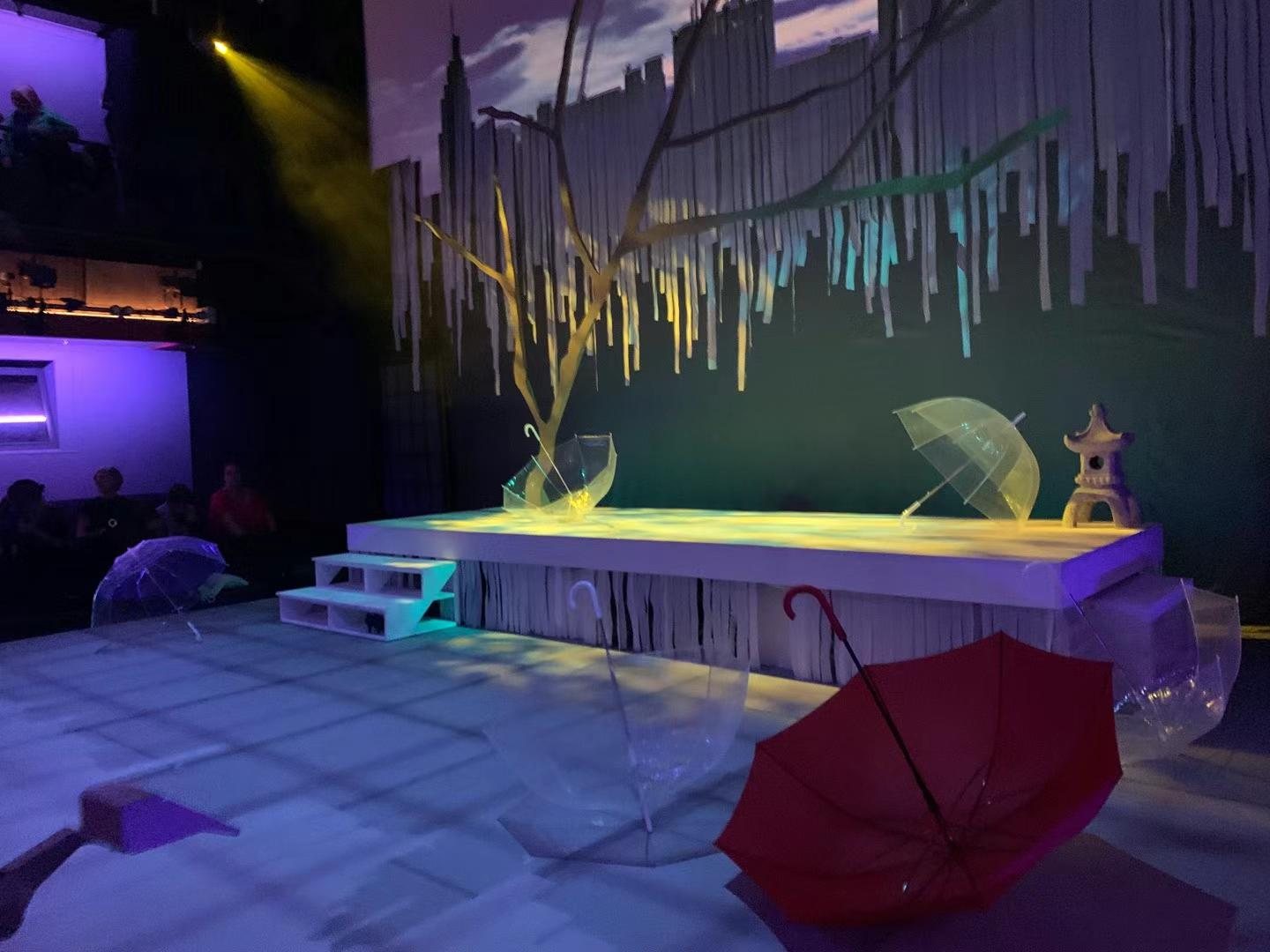
The design is decent for a small production, and the lighting deserves praise; that, at least, felt right. That’s all.
Thoughts from this seat
- What I love is a mood: silence, and blank space.
- Beautiful, but not beautiful enough.
- The music is beyond criticism; the whole show seemed to be held up by it.
 Tianjiao TanProducer and writer. Makes theatre, and sits in the audience for everyone else’s.About me →← All reviews