This was my third Les Misérables in the West End (2018, 2019, 2022); counting every version, my sixth.
It is one of the musicals I cry through from beginning to end: the tears start with the first bars of the overture and return in all sorts of unexpected places. The others on that list, for now, are The Phantom of the Opera, Hamilton and Wicked.
Front rowLess of the set, more of the faces
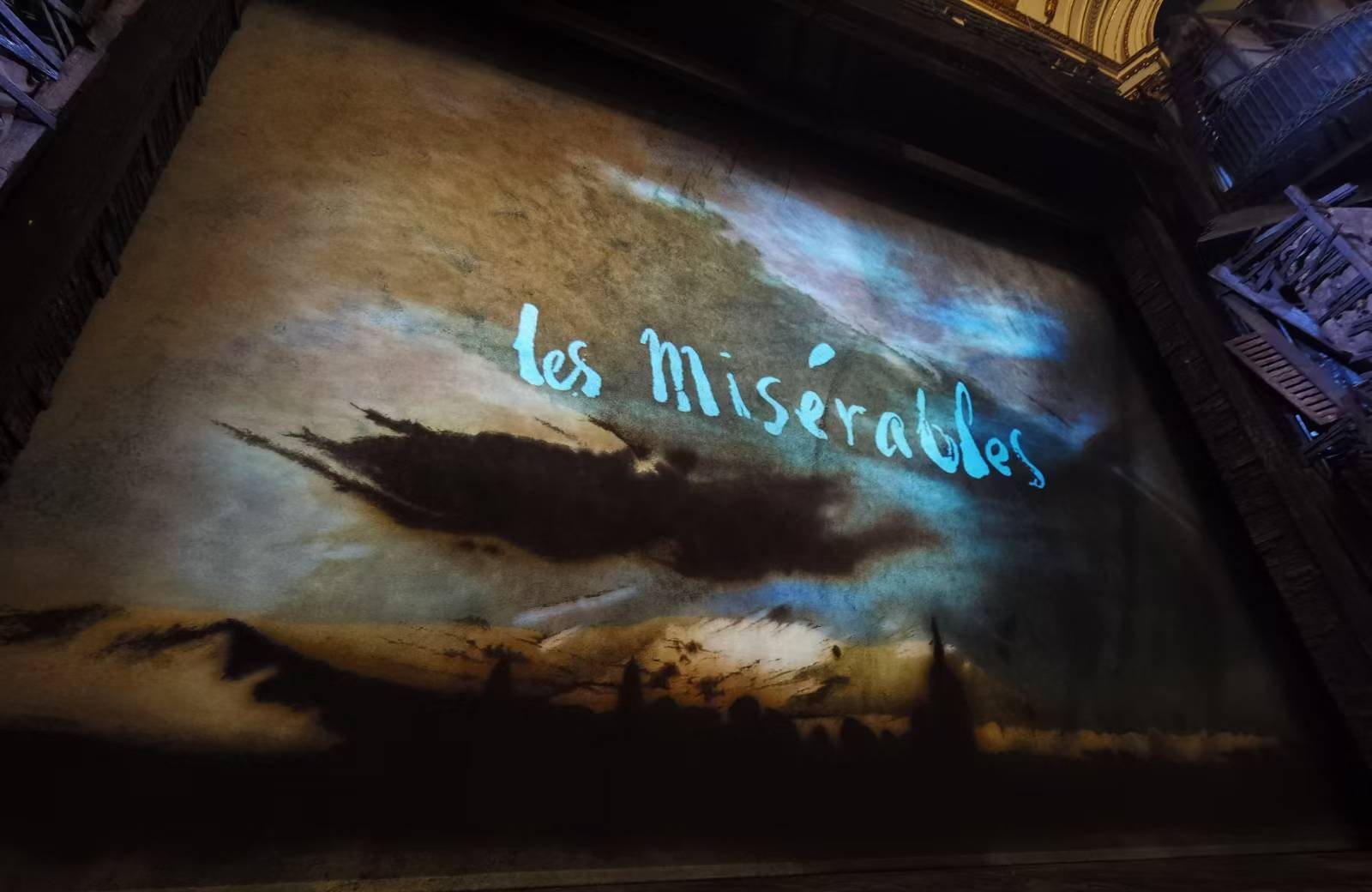
Today I sat in the Stalls, row A, seat 21, neck aching from looking up and limp from crying. I could not really take in the set; only its atmosphere was left. Set beside what I wrote on 23 December 2019, I could almost believe I had seen a different production. But a seat that is in effect the front row put more of my attention on the acting. A single expression could go straight through me: Valjean’s reluctance to leave Cosette as he dies, or Fantine’s first hatred of Valjean. The fourth wall seemed to come and go, and I found that deeply satisfying.
MemoryThe work that shaped how I see the world
I will always love Les Misérables. It is the work that shaped my view of the world in childhood and adolescence, an enormous influence and for a time my favourite novel. Later it became, alongside The Phantom of the Opera, the loveliest memory of my first two years of falling for musical theatre. I think of the older student and the friends I made theatre with then, of the Peking University production of Les Misérables, of Barricade Day and the companions I got up to things with. That alone is enough to set me off.
DetailsWhat you only see from close up
I will not repeat what I said last time about the redesign. Being so close today, I was moved by details. When Valjean has just left prison, a child falls over and he helps her up, which goes to the heart of Les Misérables: people are good by nature. In the confrontation between Valjean and Javert that comes before the barricade, Valjean already has him by the throat and lets him go, so the barricade is not the first time he spares Javert. After the police have gone, as Valjean and the Bishop talk, he pushes the whole bundle back towards the Bishop; that sense of not deserving the gift shows his conscience has already been touched. And before Valjean dies alone, he lights the two candlesticks that have lit his whole life, and they stand on stage exactly where they stood in the Bishop’s house.
“Lovely Ladies” is a very expressive number. The Les Misérables ensemble cannot be faulted as actors or singers, above all in the passage after the pause in the middle of this song, when the tempo drops and each performer finds a way of her own to play it. The helplessness of little people against the backdrop of a great age is superbly done.
The castFrom Valjean to the Thénardiers
Valjean cannot be faulted as an actor or a singer. His personal stamp is an occasional cool restraint, which I like very much. Valjean also has to be strong, and this one truly is: he lifts Marius without effort, very much as in the novel.
Bradley Jaden’s Javert astonished me. Fiyero and Javert could hardly be more different, and nothing of the performer himself got in the way of the character. It was exactly right. Had I not had a full day of classes the next day, I would have gone to the stage door.
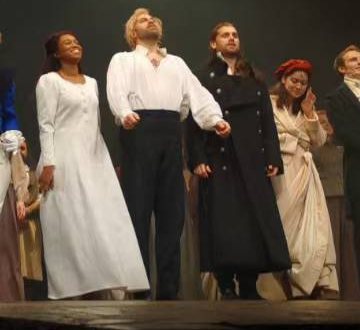
Young Cosette cannot be faulted; the feeling was really there. Gavroche seemed a little weaker to me, perhaps because the front row shows too much: you could see a good deal of “being directed”, and the role and the child had not yet become one. But the part is so winning that little can go badly wrong. Every move is carefully set, and the audience loves him.
This Cosette makes love at first sight entirely believable. Her voice and Marius’s are both on the narrow side, which makes them a good match. In the trio with Marius and Valjean before the wedding her top notes were a little thin; everything else was satisfying.
Éponine’s acting was fine, though before “On My Own” she had one hand inside her coat and the other clutching her collar, which looked odd to me. The singing was uneven. At first I thought there was a problem at the top: at times she could not quite “find the station”, and the sound went thin. I do not mean “A Little Fall of Rain”, but places that should not be thin at all, especially in duet, with Marius for instance, where a whole stretch would fade. Yet “On My Own” was very well sung, and felt. Tuning in is perhaps easier alone than in duet: once you have found the station, you can stay on it.
This Fantine has none of the stock “wouldn’t hurt a fly” quality, which suits a woman who has been through so much. Let me praise once more her hatred of Valjean and her later disbelief, and her longing for her daughter, which cost me many tears. “I Dreamed a Dream” had nothing wrong with it, and nothing astonishing either.
Enjolras is all fire, which is what the part needs most. He has a slight accent, but it does no harm. The only thing that took me out of it was the marching, when he always seemed about to break into a dance; it may only have been my imagination.
Grantaire’s drunkenness is conveyed mainly by a stoop, while nothing in his manner is drunk at all. At the barricade, when the others charge, he stays below gathering up the dead; after two he finds that everyone is gone, and climbs the barricade to die himself. I did not like this staging, which made little sense to me. Among the students, the one fans call “Big C” had presence, but apart from leading the march ahead of Enjolras he did not hold my attention much.
The Thénardiers were as lovable as ever; Madame Thénardier teasing her husband with a bent baguette made me laugh too. The Bishop fell a little short as actor and singer, lacking weight and the clear-sightedness of a man who has lived most of a life.
And, as always, I miss the revolving barricade. Javert’s leap into the river seemed today to be seen from above, and at the end he drops into a whirlpool. I am not sure whether it has changed since 2019 or whether I simply saw it differently from this seat.
HugoNone of these people is small
Neither “Empty Chairs at Empty Tables” nor the great final chorus made me sob this time. It was other moments, Valjean’s death for one, that had me crying aloud. Hugo is extraordinary. This is not a story of “small people in a great age”. None of these people is small: the Friends of the ABC, and Valjean, give me a strong sense of destiny working on several levels.
Valjean’s life is ordinary and not ordinary at all. He has done wrong, but he has done far more good, and in a spirit of giving: for the townspeople, for Fantine, once a stranger to him, for his adopted daughter. The passage in which he does not want Cosette to know the truth is deeply moving; so is “Bring Him Home”, where he would give his own life for Marius’s safety, which shows how much he loves Cosette.
What breaks Javert is not that Valjean let him go. It is that, under Valjean’s influence, he himself chose to let Valjean go. This unfamiliar self, one in which conscious and unconscious might be said to contradict each other, is something he cannot accept. Bradley Jaden played that whole sequence of inner change superbly.
What breaks Javert is not that Valjean let him go. It is that he himself chose to let Valjean go.
Thoughts from this seat
- A seat that is in effect the front row put my attention on the acting.
- None of these people is small.
- What breaks Javert is the unfamiliar self that chose to let Valjean go.
 Tianjiao TanProducer and writer. Makes theatre, and sits in the audience for everyone else’s.About me →← All reviews