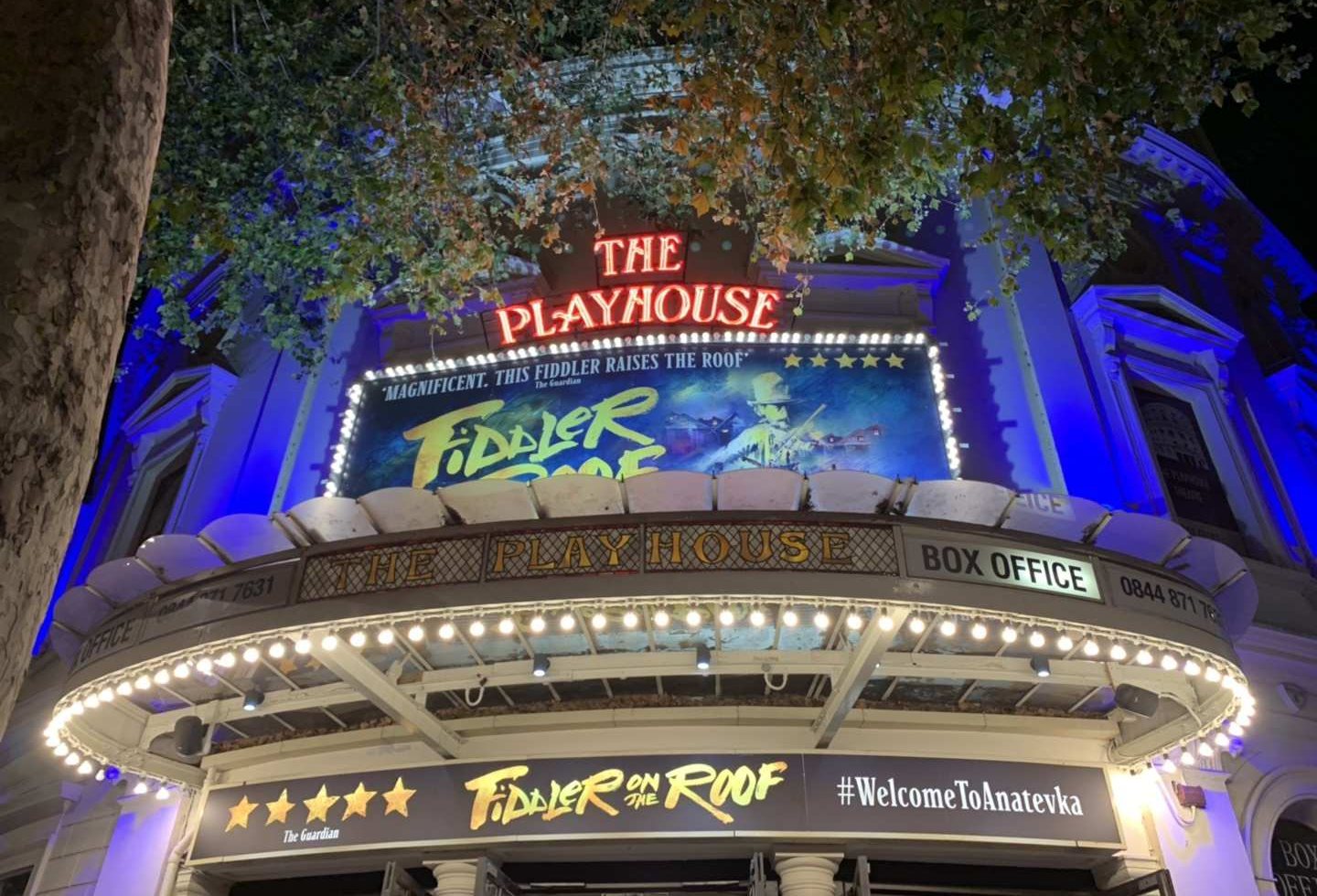
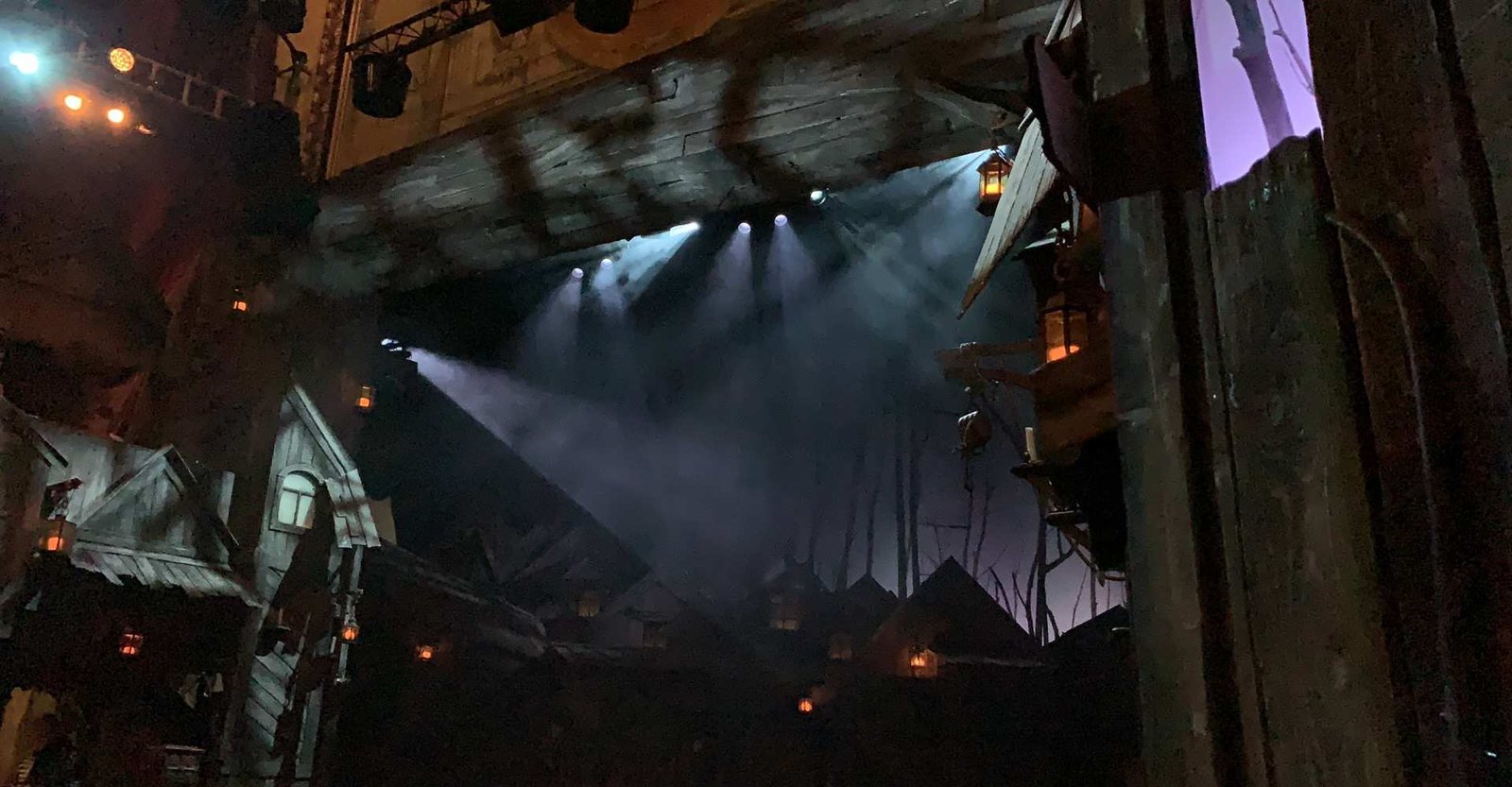
First, praise for the Playhouse Theatre. Walking in, I felt I had stepped into a wood: the little windows are covered with the shadows of branches, in the same texture as the backdrop on stage. My seat, F11, was at the side against the wall, and in the wall beside me was one of those windows, with the same small night lamp hanging above it as outside the house on stage; overhead ran a row of stage lights, hardly hidden at all. Perhaps the stage is simply too small for anything to be concealed, but nobody’s attention was stolen by the exposed lanterns. It was all on the beautiful stage and the moving story.
CastingA more finished version
This version is more finished, in its casting and in its adjusted details. The casting point is mainly Golde. Judy Kuhn, good as she was, read as too youthful for the part; Maria Friedman, whom I saw, has the air of a woman who runs the place, which in the introduction to the dream scene made it easier for me to think of “Master of the House” in Les Misérables.
Another adjustment is that Chava, the third daughter, has lost her glasses. A love of books does not require glasses, of course, but I prefer a character trait to be made visible: with five daughters in one family, it is easy to lose track. That is the one change I thought less good. Tzeitel, the eldest, is played by Molly Osborne and is much gentler, which sets her further apart from the sharpness of the second daughter without weakening the attraction of opposites between her and Motel. If anything they are better matched, and I liked it.
Love storiesThree romances that make more sense
Among the improved details, the courtships of the second and third daughters are now more convincing. In the filmed version I had watched, Chava resists Fyedka throughout their first scene; it is obvious they will be a couple, yet I could not understand how they were suddenly in love. Now, in that “first meeting” (so to speak; they have met before), you can watch the whole courtship, from resistance to a shy smile. There is a change to follow, and it makes far more sense. Another reason may be that a camera can only look at one place at a time, whereas in the theatre you can follow several things that interest you at once, and the storylines fill out as your attention widens.
What the theatre made me notice in particular was the three daughters’ three romances. In the first two, the father’s inner struggle ends each time on the word “tradition”, which means he has overcome tradition and is moving forward step by step. With Chava, that word never comes. Tradition is truly broken only in the reconciliation between father and daughter at the end: I think it is when the father reads the letter, and his expression holds all of a father’s love and concern. I was in tears at once. Sadly I was drowsy by the end (I was still jet-lagged) and, though I fought it, it took something away. I expect I shall go again to make up for it.
The first two romances end on the word “tradition”. Tradition is truly broken only in the reconciliation of father and daughter at the end.
The stageA small stage, and the dance with bottles on their heads
Because the stage is smaller, some scene changes have been dropped and the background stays almost the same throughout, without any loss of clarity. Tables and chairs make an interior; take them away and it is the street. There is no revolve, only the actors’ movement and the lighting working together. So money can be saved this way (provided the designer and the director do not kill you for it). The scale is smaller too, and I suspect the dancing is uncomfortable, especially at the wedding. The bottle dance is as brilliant as ever, but it never seemed to have quite enough room to open out.
During it, one dancer’s bottle fell from his head, and the other performers cheered him on. That must have been rehearsed: I imagine that if nothing falls the moment does not exist, and if something does it has to be handled naturally, so the audience is not pulled out of the scene. It was well done. Sitting close, I could see how taut the dancers’ faces were. This is real technique, and I could feel their nerves; the instant the bottles came off, everyone breathed out and the applause thundered. It is a superb piece of dancing.
The dreamA grandmother played by a man
Another delight is the dream scene. I love it: what but a stage can render imagination and dreams so truthfully and yet so magically? When the grandmother appeared, it suddenly struck me that she ought to be played by a man. I cannot say why; it simply felt right. I looked closely, and she was. I was thrilled. I had not noticed it in the filmed version, and could not have told from a video.
It may be as I once heard in a pre-show talk: a little satire needs a huge contrast with reality to tell us that this is imagination, a dream. On the surface, people from his real life are speaking to him, but the contrast is so strong that we can separate the two worlds sharing the stage. The grandmother’s voice seems to come from a different, female performer while the grandmother only mouths the words, and that unreality is gorgeous. The little ghosts around her wear every colour, childlike and full of imagination.
The castTevye and Motel
Andy Nyman’s Tevye is in the role almost at once. In “If I Were a Rich Man” he lets in a note of “ah, but I am only dreaming, and I do not believe it myself”, done in a thin, small voice; the inner contradiction comes across especially well in this song, and it fits a character who is forever saying “on the other hand”. But when he uses the same voice in the song he shares with Golde at his daughter’s wedding, it is uncomfortable and does not fit, as if the feeling had been pushed to the brink of its peak and we were then told that would be all for today. That song is so full of feeling that it made me think, as a daughter, that I ought not to marry and grieve my parents; and yet they are happy for their daughter, so all I could do was be moved to the edge of tears. That way of singing dragged the feeling down and would not let me cry. Everything else I would give full marks.
Motel is much better drawn. When he is handed the wedding hat, he has none of the smugness of the filmed version, where it was “the bride is mine and so is the hat”. Here it is “the bride is mine, but the hat is not”, because he has no money; and then the hatmaker makes him a present of it. That is far more plausible, because Motel is an upright, straightforward man. His line about even a tailor having a right to happiness moves me every time.
The titleThe fiddler on the roof
The chorus deserves high praise. And truthfully, it was a long time since I had heard a musical with a live band, and the music was a deep pleasure. The fiddler himself is in plain view, really up on the roof.
The title remains fairly abstract, of course. The explanation you find online is that their lives are as precarious as a fiddler on a roof, and that is one reading. But I would start from the painting: the exclusion and oppression of the Jews is like a funeral, and the fiddler on the roof, though he is at a funeral, lives in his own way. Too optimistic, perhaps, but at least he hopes for something. In danger, and unafraid.
The brilliance of the show is that it exposes a society that shuts out the Jews and is at the same time filled with boundless family love. (Truly, I expected the father to be the obstacle to every romance; I never imagined he would be the one pushing things forward, or that we would watch him change.) A pity that, apart from a five-pound programme, there was no merchandise at all.
An asideSeat F11 and a blown kiss
One funny story. My seat was the innermost one, and when I booked I had no idea F11 was at the side (the seating plan for this show on TodayTix is very inaccurate). The centre aisle does deserve praise: it is the actors’ entrance and exit and leads straight to the stage, so the effect is very immersive, and I really felt I was at that wedding. I did not arrive especially early, and an elderly gentleman on the aisle had to stand to let me in. He was a wit. He patted his cheek and said he would not let me pass without a kiss. I said he must be joking; he said he was not. In the end I blew him a kiss and asked whether that would do, and he laughed and let me through.
Thoughts from this seat
- In the theatre, the storylines fill out as your attention widens.
- Tradition is truly broken only in the reconciliation of father and daughter at the end.
- In danger, and unafraid.
 Tianjiao TanProducer and writer. Makes theatre, and sits in the audience for everyone else’s.About me →← All reviews