The songs are gorgeous, entirely in a style I love. Nearly every one is good, but I must single out “Spirit of the Earth”, which returns as a reprise at the very end.
The storyWhile the predicament of gender lasts, works like this matter
The story is adapted from Kahlil Gibran’s poetic novel, and the book and lyrics of the musical keep some of its poetry and beauty. As a story it would not stand out today, but as long as the predicament of gender lasts one more day, works like this still mean something. What surprised me is that in 1912 a male writer from the Middle East could see so clearly; though I have not read the original and cannot tell how much of the musical is new invention.
It concentrates on Gibran and his first love: on the corruption of religion (I did not hear many lines that dealt with religion as such) and on traditional rules that drive people mad and destroy them. The discussion of tradition reminded me of Fiddler on the Roof, but this show uses much heavier means. The position of women is part of that tradition. Her marriage is settled in a single conversation by her father, and all she can do is be informed. And her repeated insistence that “it is my father’s wish” shows how the will of a father she worships and reveres has, to a degree, extinguished her own agency. It is a surrender she makes herself, which is sadder still, like a woman schooled into being a willing housewife.
In “Be Free” she breaks out briefly, and as a married woman insists on meeting Gibran in secret once a week; but in the end, bowing to the world, she kisses him goodbye. (I rather think that what upsets the balance and pushes her towards parting is that she is carrying her husband’s child.) After that it could not be more tragic: the child dies, and she dies too, of a haemorrhage. This passage is very well played, and the breath in “Rescue Me” makes you believe absolutely that death is near and all hope gone. In death neither she nor her son has a grave of their own; the two are buried with her father, three together, which hurts even more. The show’s method is to force you to think by wounding you with the plot. There is also something of the tragic quality of Romeo and Juliet: the plot is very simple, yet it never feels thin.
All she can do is be informed.
The theatreImmersive to the eye, a fourth wall in the acting
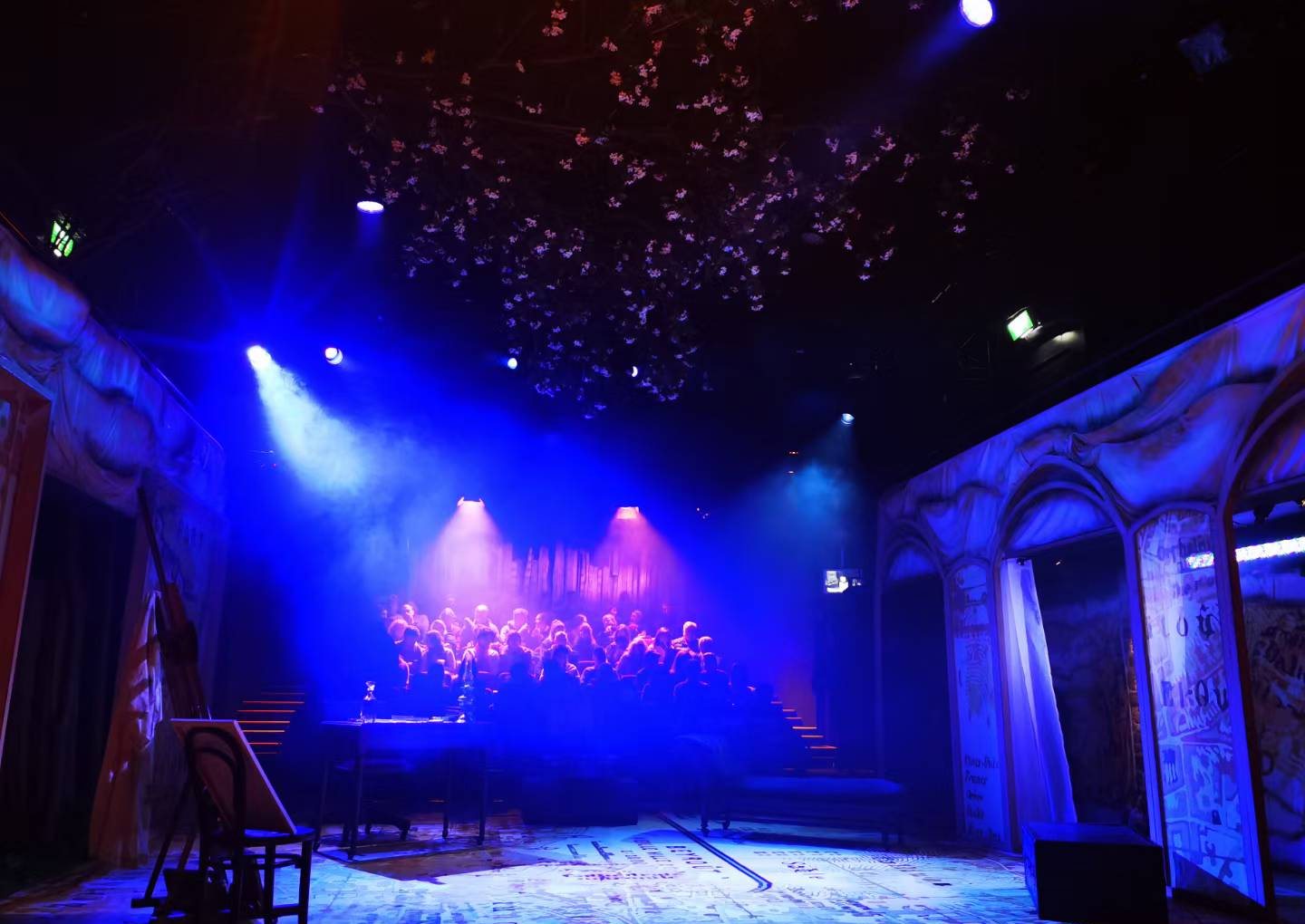
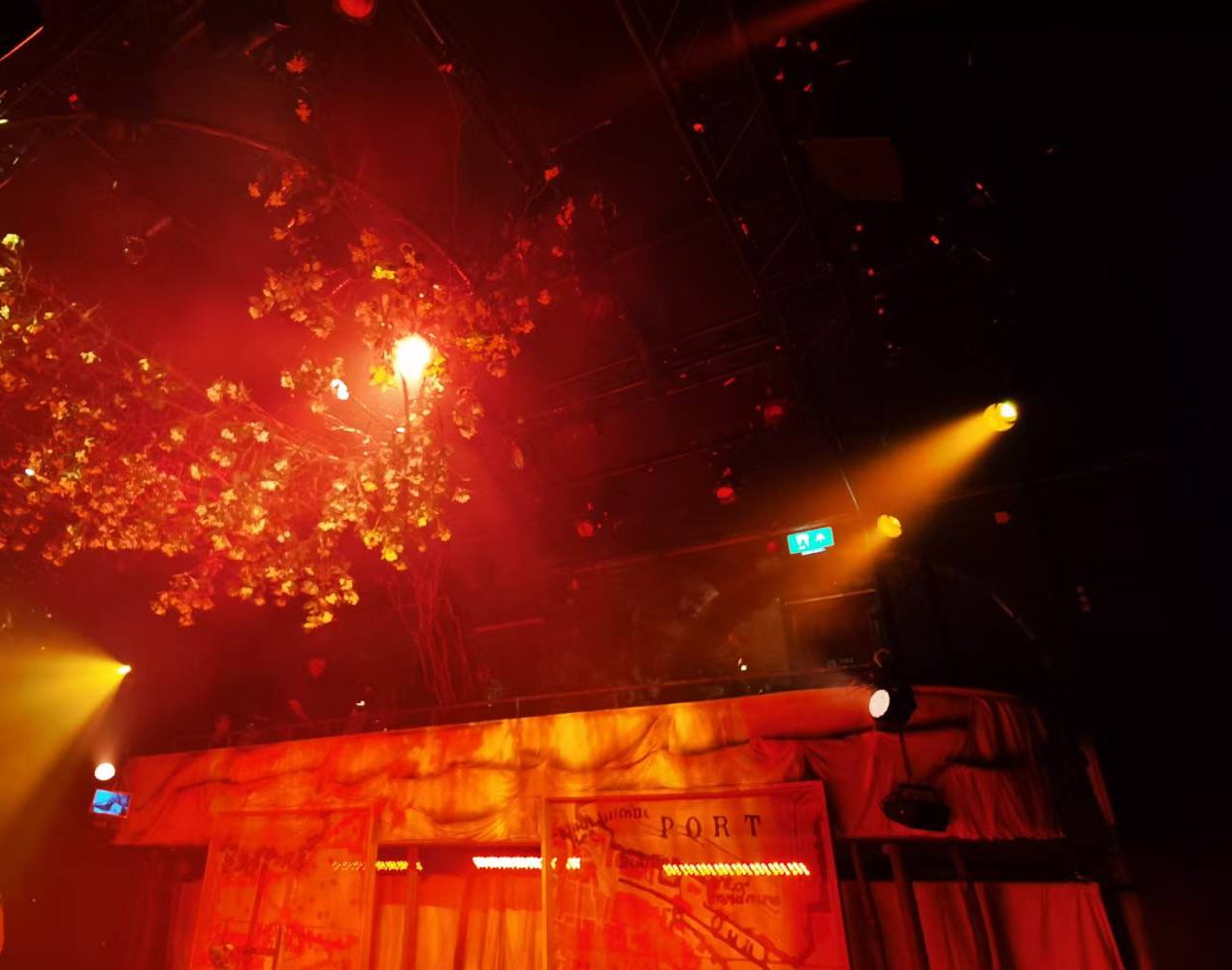
I like this theatre very much. It was a small house before the conversion, and with the stage moved to the centre it has become a true studio. The key word for a studio is immersion, and the design achieves it visually. The palette is cleverly used to wrap you in atmosphere; the pattern on the stage floor runs on under the front-row seats, and the two sides share the same tones, even the same pattern. That is where the immersion comes from. The performance itself is not immersive, of course: the actors establish a fourth wall. But the visual setting is, and the combination is intriguing, like watching in a dream, as an onlooker, everything that is happening to you.
There are things in the design I cannot quite agree with. I never understood what the grass walkway was for. It looks pleasant enough, but I could see no need for it; the blocking in this show is odd to begin with, and the walkway makes it odder. Then there is the upper level opposite the band, which is all but useless: actors climb up to sing there merely to mark off another scene, or simply to add a visual level. Better to stand the actor in the back rows of the audience with a follow spot, put chairs on that level and sell them.
Blocking and lightingMoments that broke the spell
On the blocking, what stays with me is the scene in which the heroine’s father is dying. He sends Gibran to fetch her; Gibran heads for the walkway, and at the same moment I watched her leave by the walkway’s other exit, like a game of cat and mouse. Then he went out the same way. Nor did the light on the father’s sickbed dim to tell me we were now in a different scene.
Speaking of “a different scene”, there is also the one in which the heroine’s marriage is settled. Once it is agreed, her father exits; uncle and nephew sing most of a song; then the father comes back and finishes it. I would love to know where he was in the meantime. If the lights had gone down on uncle and nephew, I could have read it as a cut to wherever the father was. But there they still were, drinking and making merry, and it does not add up.
On the lighting, I should mention the “spirit leaving the body” device. For the father’s death it works reasonably well: a shift, I think, between yellow and white, clear enough in contrast, with everyone else carrying on as they were and only the father’s own light turning white. At the heroine’s death I noticed no obvious change of colour, perhaps because the light was cool already, so she simply seemed to come back to life, which broke the spell. In fact the moment the father sits up startled the audience a little too. His movement should be cleaner. He first drew back the hand that was hanging to the floor, and only then rose; that seems to me unnecessary. The first thing we notice should be the rising itself, or it becomes awkward.
The snow in the first half made the company’s budget look tight, and since it never falls on anyone’s head, it is another half-measure. The scene change to the ruined church, flown in on a pulley, I rather liked: all it takes is a long enough rope and a hook, and one actor can pull the tattered cloth down from the upper level, carry it across to hook on at the far side, then haul on the other end to raise it.
The bookSongs that arrive abruptly, and the narrator I like least
The book has some problems. Several songs are introduced abruptly, rather forced, with little connection to the line spoken just before. This must be very hard to do well. I know the show handles it crudely, but I need to do some research of my own to make sure my work does not make the same mistake. It was a useful warning.
Then there is the older Gibran, who serves as narrator. Anyone who knows me knows that the narrator is the device I like least. I take it as a sign that the writer has run out of ways to keep the action going and has reached for a voice-over to join things up. If I wanted a text read aloud, I would not need to come to the theatre. In this show the joins between narration and action are mostly smooth, and I dislike it all the same. Whenever the older and the younger Gibran sing together (apart from the beginning and the end), there is no real need for it; it feels like an excuse for a duet. Beyond the one entering as the other leaves at either end, I could see no bond between them in the middle. “Memory” as a form seems to me conjured out of nothing in the making of this show: it has no necessary reason to be there, though one can be argued for. The programme says the show also wants us to feel Gibran’s own philosophy. Very well; this is a crude way of doing it.
The business of reading from a diary also took me out of it. When the hero goes to Dima’s house to pour out his longing, he sings holding a diary, and more than once I thought the words were written in it and he needed to read them. When you sing, you are already singing a state of mind and have already left the real world; looking at a diary only forces a link between the younger and the older man. Only at the very end, when the older man watches his younger self sit down and begin to write a poem, did I feel an exchange between the two that needed to be there.
What moved meA kiss on the forehead
The parting song really is lovely, the hero’s first verse excepted. One detail is very touching: at the end the two seem about to kiss, but she pushes him away and kisses his forehead. They keep to that through the weekly meetings after her marriage, each kissing the other’s forehead; which is why, when they do at last kiss at the great parting, it is so desolate. The lighting for this passage, though, is not attractive: colours changing not quite on the beat, to no purpose I could name.
The second half opens with the wedding. It is worth saying that the writers judge very well what to dwell on and what to pass over: the affair itself is dealt with in a stroke, with great economy.
When the father’s spirit leaves his body, he turns half-way to look back at his daughter, and that moved me. Still, both his dying speech and his lightness after death create the sense that dying means setting down life’s burden and ending a hard journey. I do not know whether that was Gibran’s intention. After the heroine’s death the music suddenly swells; and because the music is so beautiful in itself, the effect was overwhelming.
The show does not only say that this tradition destroys girls. The heroine’s husband suffers too, and is in some measure a victim himself. It is just that he cares nothing for her and carries on carousing; set beside the women, his lot is not hard enough. The scene of the baby’s death is suffocating, above all because every piece of bad news is set against the laughter of husband and uncle drinking in celebration. The irony could not be sharper.
Characters and castWhy Dima is there
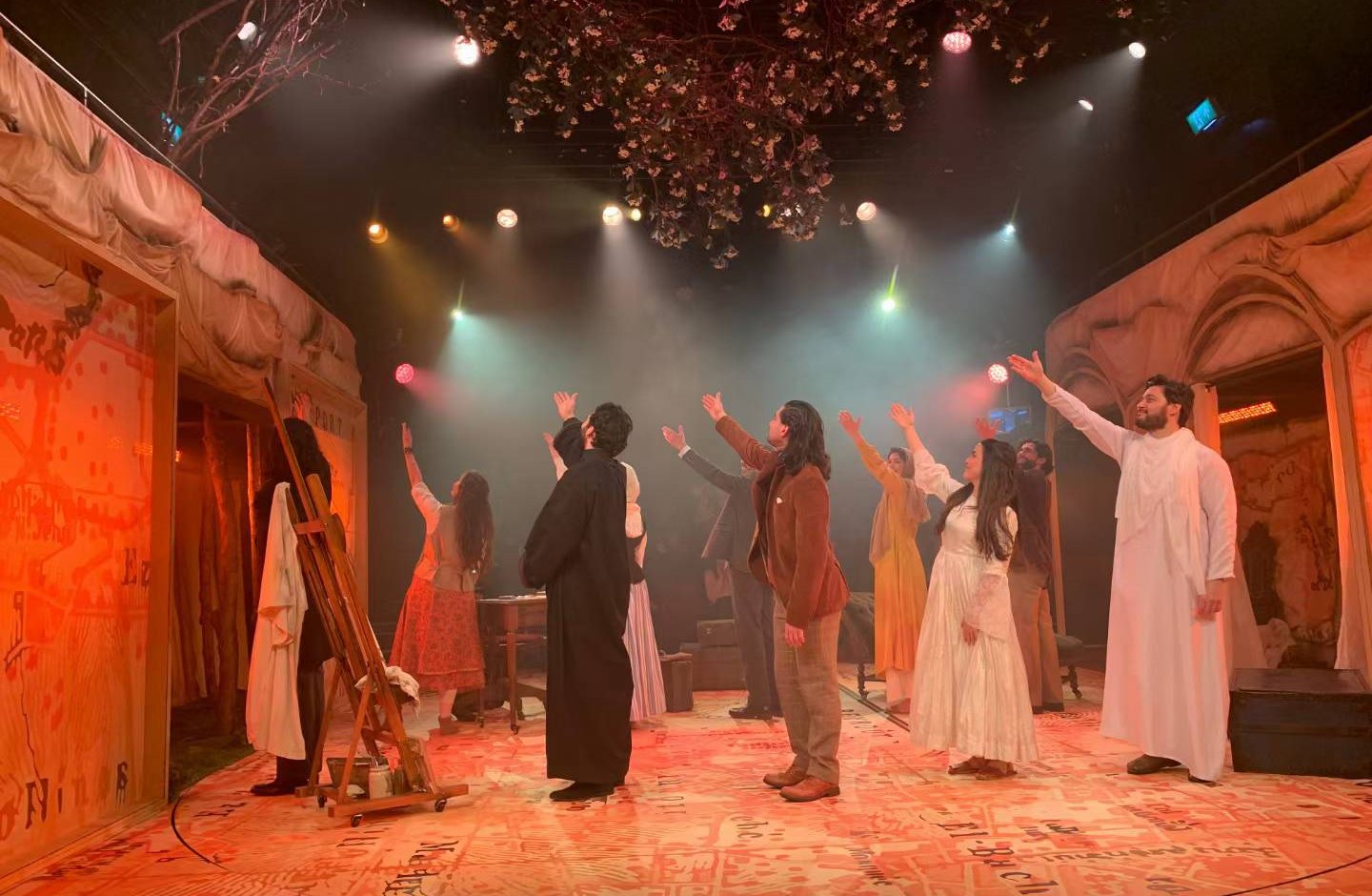
All this weight explains why the character of Dima exists. She is the hero’s friend, and she also carries women’s hope: we are moving forward. Ending on the melody of “Spirit of the Earth” is right as well. Had the close been heavy, the audience would have gone home unhappy.
The ideas of Mother and Home in this show I did not fully grasp; perhaps they belong to Gibran’s own struggles and reflections outside the story, and I will leave them there. The actor playing the mother did not quite land her opening high notes, but settled afterwards, and the tone is lovely.
The hero’s manner is very heightened; whether by direction or by temperament I cannot tell. Even for a poet there is no need to be quite so worked up, and his top notes were thin. The heroine delivered. I want to praise the actor playing Dima in particular: she belongs on a stage, sings superbly and acts with a fluent naturalness that shows almost no sign of effort, every mood and small gesture in place. I liked her so much that, for once, I waited at the stage door. The older Gibran is played by one of the composers; performing in a show he wrote himself must be a great pleasure.
The programme is cheap: £3.50.
Thoughts from this seat
- As long as the predicament of gender lasts one more day, works like this still mean something.
- If I wanted a text read aloud, I would not need to come to the theatre.
- Immersive to the eye, with a fourth wall in the acting.
 Tianjiao TanProducer and writer. Makes theatre, and sits in the audience for everyone else’s.About me →← All reviews