I do love a psychological drama, and this one had my heart in my mouth. As I watched I gradually guessed that the hero is himself the patient; as the plot advances, the hints of “delusion” grow plainer. Yet I never had quite enough evidence to believe that the delusions come simply from trauma, and not, as Teddy says, from an experiment in which the doctors have taken control of his mind and used his old trauma to plant memories and opinions in him. For a long time I could not tell what was true and what was false. Not until the ending: I trust a film to finish what it starts, and to end on a full stop, not a full stop followed by a closing quotation mark.
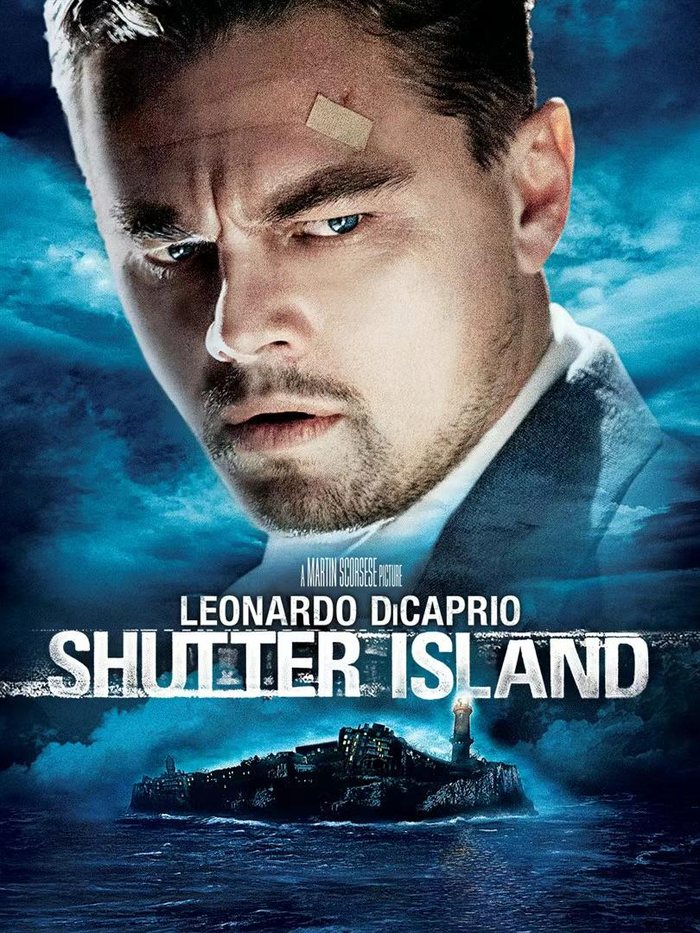
A good thriller releases its signals a little at a time, so that different viewers can guess more or less of the truth at different points. With Dr Sheehan, I guessed at the word “RUN”. Bridget Kearns knows his condition as well, and looking back I do not see why, at that point, the hero is deliberately allowed to believe in a conspiracy. Perhaps that is exactly the doctors’ strategy: let the patient play his game out. The deeper he goes, the further he drifts from reality, until the collision of incompatible truths shocks him back into it.
The endingWhich would be worse
The ending is the finishing touch. As Dr Cawley says, his condition runs in cycles, and sure enough, at the end he is back inside the identity he has invented. But at the moment he sees the orderlies coming towards him with their instruments, he says something that shows he has remembered.
He asks which would be worse: “to live as a monster, or to die as a good man?”
The answer hardly matters now. He has made his choice. In that moment he is not living in his delusion; he knows what his condition is, and the choice is his own. Life and death here do not have their ordinary meaning. To lose one’s memory and one’s sense of the world is a kind of death, but it is a choice that the living man makes for himself. Perhaps only the death of memory, or of the self that carries the memory, is a real farewell to it. And I believe that while he is the “monster” he could not ask this question, let alone make a choice. To be able to ask the question is already to have answered it.
AfterwardsThe uncontrollable, and the unreal
It leaves you feeling that being human has its painful side. We may once have believed that everything could be controlled, or at least that we could control ourselves, only to find that at some level we cannot. It was always so, and it follows from how we are made: whether in patients said to be mentally ill or in perfectly healthy people, gravely or slightly, these “uncontrollables” are there. Or perhaps the mistake is this: people are uncontrollable by nature, and yet they conceive a desire to control. But then, that is what people are.
After the film the world around me felt unreal. Or perhaps there never was any such thing as the real: everything I think, and everything that reaches my senses, has passed through my own filter and even been reworked by it. I suppose so. But what of it? We move with the universe and take things as they come; there is no need to insist on the real. Taking things as they come means that I am perceiving, so I shall go on perceiving this lovely world.
An aside: more a record of life than a formal review. Poster © the rights holders.
 Tianjiao TanProducer and writer. Makes theatre, and sits in the audience for everyone else’s.About me →← All asides