I finished Se7en today, and was left without words.
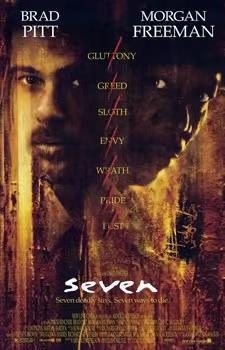
Once he gives himself up, you can more or less guess that the killer himself will be the last; what I did not expect was that he would complete the final link of his “performance piece” by provoking Mills. I thought he would submit to the law. But then, of course, it would not be so “stunning”.
You cannot help asking what John does all this for. To preach? To me he is a man living in a world of his own, punishing those who deserve punishment under his own law; it is only the influence of his reading that makes that law coincide with the seven deadly sins. And when someone is self-absorbed enough to interfere in other people’s lives, his law comes down to gratifying his own desires: the desire to torment, the desire to toy with people, the desire to make the world run as he sees fit.
Making the world run to your own design sounds dreadful at first, yet it can be read another way: the world is in a terrible state and we want to change it, but the order of this world is just as bad, so I will live by a law of my own. It can go well or badly. There is no settled answer.
But without going so deep, take the plain facts: how can one person have the right to decide whether another lives or dies? What, to be fair, has the glutton done wrong? Are the seven deadly sins necessarily reasonable? Is everything you were taught reasonable? Every “maxim” with a hole in it ends up as shield and accomplice for those who do evil.
Every “maxim” with a hole in it ends up as shield and accomplice for those who do evil.
Mills“Envy” wins, and “pride” is punished
The saddest thing is that Mills does fire, and John has calculated it all too exactly. The serial killings are less his wicked purpose than the destruction of Mills’s life. So much for punishing the wicked by the seven deadly sins. On the ground of “envy”, John “succeeds” in destroying Mills; he is the winner. Must survival be the measure of who wins and loses? That is a sleight of hand. Look at the outcome: “envy” wins, and the envious man gets his wish.
At the same time it is surely Mills who stands for “pride”, and pride is indeed punished. What he has is mostly confidence, but confidence mixed with contempt for others, and so with disrespect, which is not attractive. It set me thinking again about good and evil. I still believe that evil cannot cure evil; to expect a wicked man to see the light because he is punished has no logic in it at all. It is hard to say what becomes of Mills. A lifetime of remorse in prison? A new start? A life lived in greater resentment, turned against the world, the reverse of his wish to make it better? Numbness? Is this world worth it?
The old detectiveHe chooses to stay
The old detective’s last line, borrowing from Hemingway, gives his answer. He had meant to get far away, but he cannot bring himself to, and in the end he chooses to stay and go on doing something. I do not entirely understand his motive: how does this last case change him? Does it show him that the world is in such a state that he had better do what he can? Or does the whole sequence of events clear a heart that had grown uncertain, so that he walks on firmly, carrying the zeal Mills once had? He looks on this world with compassion, and that such a man is granted something good is, more or less, a consolation for the audience.
I would like to look further into John’s background: whether he really is mentally ill, whether he has met with too much contempt from the world and is taking revenge, why he is so extreme. Another time. A single viewing always misses things, and this is a film that makes me want to read how others have understood it.
(These notes do not set out to decode what the film-makers had in mind. They are only my own reading.)
An aside: more a record of life than a formal review. Poster © the rights holders.
 Tianjiao TanProducer and writer. Makes theatre, and sits in the audience for everyone else’s.About me →← All asides