The third film I watched on the plane today. Frankly, I do not rate it very highly. I kept waiting for a great reversal, for the story to dig out some deeper meaning, and all that came was the small matter of Dr Chang having lied to him about the cancer.
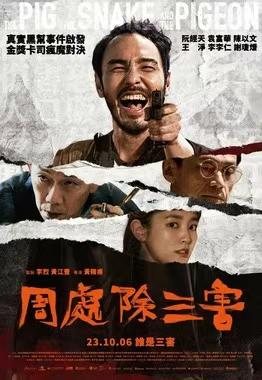
What shocked me was the scene in which Chen Kui-lin wipes out the retreat, shooting everyone who remains one by one, as if in a video game. The speed and the ease of it: he has become addicted to killing. So what is this talk of doing good? From the start he copies Zhou Chu only so that his name will go down in history. The tiger and the dragon, of course, leave no names, and none of this has anything to do with turning towards the good. Unlike the Zhou Chu of legend, who truly reforms and becomes a loyal minister and general, he is in a moral fog to the end.
I do often come across Chinese stories I cannot accept: that the orphan of Zhao’s life counts and an ordinary son’s does not, or that parents may decide whether a child lives or dies. In the story of Zhou Chu there are points that matter. First, wrongdoing must be punished, and only then can we speak of the merit of mending one’s ways. Second, how can we be sure that Zhou Chu has truly reformed and is not simply intoxicated by fame?
Dr Chang is a distinctive piece of characterisation. As a doctor who saves lives, she is conflicted too. She need not have had to choose between saving a man and standing on the side of justice; saving someone does not have to mean helping to the bitter end, blindly and without limits. This is less Chen Kui-lin’s redemption at the end of his life than hers. Yet she is wrong as well. How many innocent lives at the retreat are lost along with the “scourges”? Was that necessary?
The film has a great many fight scenes, and brutal ones, which I found hard to watch. And I really must take issue with this poster and another like it. Is firing a gun a cheerful thing? To give the poster the look of a comedy: evidently anything goes, if it sells.
CorrectionThey may not be innocent, but he has no right
A good many of those killed at the retreat would not in fact count as “innocent”. At the least they might face administrative penalties or a warning for assisting a cult; at worst, where their part led to a death or other grave consequences, a sentence of three years or more, up to life imprisonment. Even so, Chen Kui-lin has no right to pass sentence of death on them and carry it out himself.
After the show: the conversation
A morning’s argument with a friend, Ah Bei, after watching, cut down to each side’s main points. Spoilers.
Question 1Are the people killed at the retreat innocent?
- Ah Bei
- No. He told them to run, and he let go everyone who showed fear at gunpoint. Those left were the unrepentant, people who had taken part in burying Chen Kui-lin alive and had probably killed many times before, to be so numb. Before the burial, the senior followers present were all calling for his death; tried in a court, they could not escape as accomplices. At most there would be degrees of guilt.
 Tianjiao
- They had “probably” killed before, and a trial cannot run on “probably”. Those who joined in the calls to kill are certainly not innocent, but Chen Kui-lin executes them himself, in disregard of the law. People who were coerced and deceived, like the boy’s mother, would be dealt with more lightly; and even someone sentenced to three to ten years does not deserve to have their life ended so summarily.
Question 2When the law fails, is taking it into your own hands justified?
- Ah Bei
- Do not be too hard on acts that uphold right and drive out wrong. The world keeps sliding downhill precisely because it is too kind to the wicked and too hard on the good. If the law really worked there would be no Chen Kui-lin; figures like a “godfather” are necessary. Society falls into disorder because the law protects the wicked more than it punishes them, not because good people act for themselves when they are denied justice. The rule of law presupposes that the law can be enforced, not that it is a scrap of paper in the face of evil.
- Tianjiao
- If the law is imperfect, the question is how to perfect it. Overturn it outright, with everyone a Chen Kui-lin, and society only descends into chaos and goes backwards. I do not support the existence of “godfathers” in today’s society. In the end this is a discussion about the rule of law, and our basic ideas differ.
Question 3Does Chen Kui-lin count as a “good man”?
- Tianjiao
- That he removes the other two scourges seems to me a good thing; but he also kills people who should not have been killed, and that is disorder. And how do we define him as a “good man”? He only wants his name to live on, and his sense of good and evil is blurred.
- Ah Bei
- He is a martyr, and not everyone has the courage for martyrdom. He rescues Hsiao-mei and asks nothing in return; he risks his life to save that child and warns the people who have been taken in; he has scourged himself and sincerely repented. Underneath all of this is his goodness. Instead of blaming him, ask why the three most wanted men could go free.
An aside: more a record of life than a formal review. Poster © the rights holders.
Tianjiao TanProducer and writer. Makes theatre, and sits in the audience for everyone else’s.About me →← All asides