Her Story is so, so good! Calling it a landmark in Chinese film history can’t be going too far. It hits home in so many places, all of them worked in without the least strain, because it is simply a picture of how we live.
It is also a joy to watch. In films made by old men, the women are forever housewives “idling” at home, schemers playing innocent, a ten-minute diversion, or career women who will never have love. This film has a man content to be used, a man with no wish to chase a career, a man with narcissistic personality disorder, and a band full of men who take themselves far too seriously: a good slice of the real world.
If I had to find fault: the women are drawn full, alive and in the round, while the men lean towards caricature. Men who will actually sit down and read feminist theory, for one: what share of the world are they? Most people still don’t know what feminism is. But those scenes supply a great deal of the satire and the laughs, and creating such characters at all is an act of resistance against old-man storytelling, which matters. So I see this one from both sides.
Where I saw myselfXiao Ye’s hunger for love, Tiemei’s pride
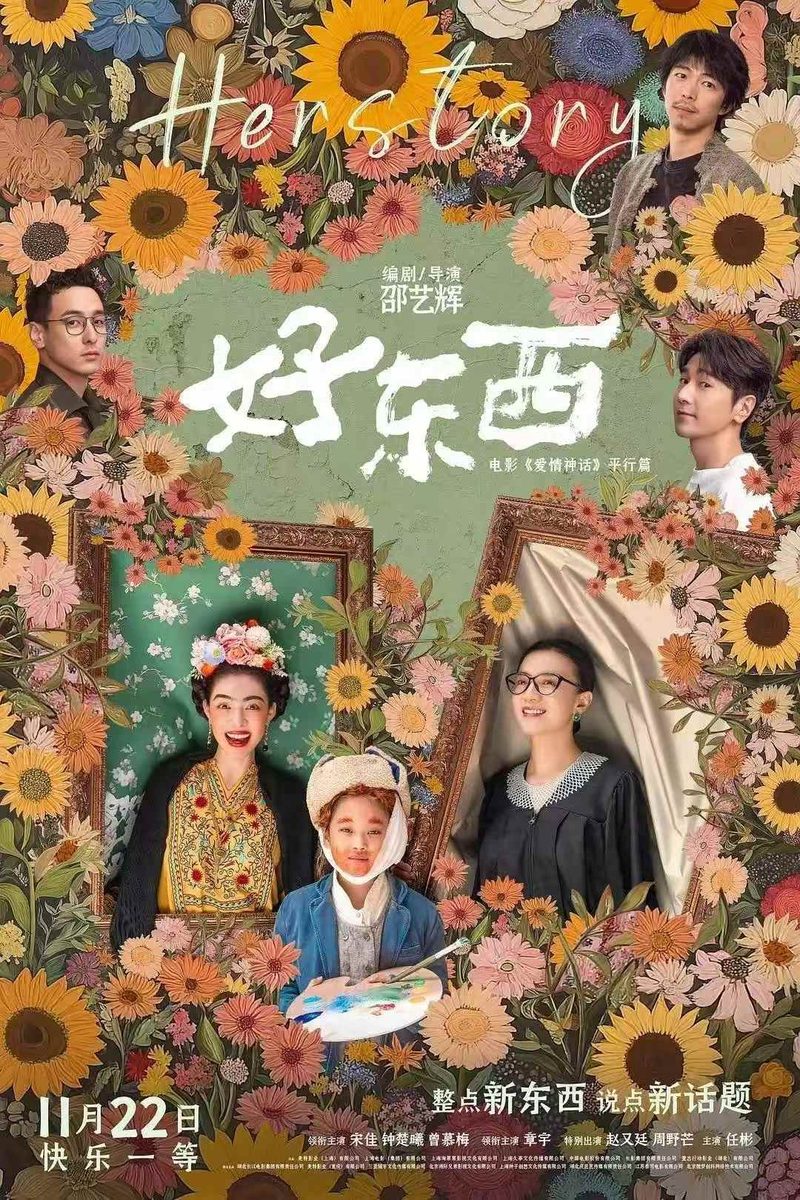
For me the pull is Xiao Ye’s hunger for love: eager and longing in intimate relationships because of it, and yet they rarely end well, and she wears herself down. Having both parents does not mean you are never short of love; the older generation misunderstands this badly. Ten hard years, and things are better now, but I still feel it deeply.
Tiemei is every inch the heroine of her own story. I recognise some of the ways she thinks and the knots she ties herself in; I see myself in the countless details of a life where she does everything herself and can do anything; I feel her courage and her fight, and also her streak of timidity and indecision. That streak is exactly what makes the portrait so good. Being a fearless warrior is not that easy: once there are people and things you care about, you cannot charge ahead on courage alone.
I recognise her perfectionism too: the harsh demands on herself, the misery when she falls short, and the wearing down that follows. So the scene where Xiao Ye comforts her on the balcony went straight to my heart. So what if you don’t do it well? Accept that you are not perfect. Nobody is superhuman, and spare me the line that motherhood makes you strong. Strong, my foot.
Being a fearless warrior is not that easy.
Dr HuSatisfying, though the motive is a little thin
A word about the narcissist, Dr Hu. I don’t know what happened in his family to make him this way. When he has her, he is incapable of valuing her; when he thinks Xiao Ye has tried to take her own life, he dismisses his “harem” to prove he means it. And Xiao Ye, close to retching, says she cannot love him any more, which is very satisfying.
I do think the motivation is a little weak: from everything we have seen of her, she is not someone who cuts things off cleanly. I believe she would lose interest once he started clinging, but that takes time; it doesn’t happen at once. It reminded me of Qin Xiaowu in Flourished Peony: that ending makes you angry, but it is exactly what she would do.
Mother and daughterThe mother I would want to be
The thread between Tiemei and her daughter is very moving. If I have a child one day, this is the mother I would want to be; she overlaps about 80 per cent with my ideal. She isn’t perfect. When the child is afraid to go on stage there is a moment when she pushes; she decides, without asking, that the child will learn the drums; and she misses what is going on with her daughter’s friendships at school. But she leads by example, and what she gives her child, integrity and courage, a sense of being her own person, all that reading and knowledge, cannot be bought.
The last scene had me in tears as well: “because I am an optimist, I can look pessimism in the face” turns out to be something the mother wrote in a news report the year her daughter was born. What that small detail tells us is that the mother has already become her daughter’s model, the lamp on her road. So warm.
Tiemei and Xiao YeUnderstanding, tolerance, and one laugh I didn’t follow
The understanding, tolerance and love Tiemei gives Xiao Ye are beautiful too, truly beautiful. In the scene where she finds out that Xiao Ye lied and claimed to be her daughter’s mother, the reaction surprised me. Tiemei shouldn’t be that possessive, it seems to me; I couldn’t quite see why she loses it and then laughs, and I don’t think the moment is well handled. Xiao Ye laughing along feels out of place as well. Still, Xiao Ye’s people-pleasing comes through in every scene and makes your heart ache. In Tiemei’s place I would forgive her too, and understand, and give her a woman’s love.
The shots of the three of them sharing a life are gorgeous, and so is the one of Moli walking on stage. The sequence where Xiao Ye plays Moli different sounds, with Moli’s guesses set against what they really are, Tiemei labouring to keep life and the household going, is directed superbly. It is a clever device, simple, and it carries depth. Nobody tells us in words how hard a mother works, or scolds a daughter for not seeing it; the facts are simply laid out, and the audience is left to take them in.
Her Story really is a good thing. I recommend it to every person in this world.
After the show: the conversation
An exchange with a friend, Chestnut, after watching, cut down to the points. Spoilers.
Why is Tiemei so angry, and then laughing, when she catches Xiao Ye’s lie?
- Chestnut
- The scene has its causes. She knows about Xiao Ye and Dr Hu. As a mother she missed how bad Moli’s short sight had become, and she is too proud to admit she hasn’t managed both her work and her child. She has also said that, whatever happens, it should not be Xiao Ye who takes Moli to have her eyes checked: she is the mother. So when it turns out the eye appointment was really a way to see that man, she covers for Xiao Ye and is furious the moment they are outside. The anger is real: her gut tells her Xiao Ye is so love-struck she will lie in front of a child and even use the child as a pretext for a date. But she can also see that Xiao Ye does care about Moli; that is why she noticed the eyesight and took her to a doctor. The glare and the laughter are how she lets the anxiety and tension out. It is more than possessiveness; it is richer and goes deeper.
 Tianjiao
- The feeling when she comes home that night I understand. But later, at the biennale, when she runs into Dr Hu and learns that Xiao Ye has been calling herself the child’s mother, she shakes off Xiao Ye’s hand and strides out. Why that degree of anger, I still can’t see. Would someone with a core as strong as Tiemei’s turn anxious and tense only after the event? For her character it may be an overreaction. And if a feeling needs expressing, a line of dialogue can help: in their fiercest argument it is perfectly clear what each of them is upset about. Here it is all guesswork, and it took me out of the film for a while.
An aside: more a record of life than a formal review. Images: a still and the poster of the film, © the rights holders.
Tianjiao TanProducer and writer. Makes theatre, and sits in the audience for everyone else’s.About me →← All asides